If you are searching for a caregiver program Ontario checklist, identify the immigration pathway before collecting paperwork. “Caregiver program” can refer to different federal and provincial processes, and documents for one stream may not apply to another.
The safest approach is to confirm the correct pathway, review its current instructions, and then check every document category against the applicable list. The seven checks below can help prospective caregivers, employers, and families organize that review.
First, identify which caregiver pathway applies
A checklist is useful only when it matches the application. The federal Live-in Caregiver Program, Home Care Worker Immigration Pilot instructions, and an Ontario Immigrant Nominee Program checklist are not interchangeable.
| Pathway or checklist | What to verify | Why it matters |
|---|---|---|
| Live-in Caregiver Program | Whether the applicant fits the limited situation described by IRCC | IRCC states that the program is closed to new applicants, subject to a limited route for certain existing program work permit holders. |
| Home Care Worker Immigration Pilot | The applicable stream and applicant situation | Different streams may have different forms and document checklists. |
| Ontario Immigrant Nominee Program | The Ontario category being used | Provincial requirements may apply alongside federal immigration requirements. |
Before gathering documents, review the official Live-in Caregiver Program information, the relevant Home Care Worker Immigration Pilot instructions, and the OINP document checklists.
1. Confirm the stream and its current status

Write down the full name of the pathway and confirm whether it is open to your type of applicant. Note whether you are applying from inside or outside Canada, whether you already hold a work permit, and whether an employer or Ontario nomination is involved.
This prevents a basic but serious error: preparing documents for a program that does not match your status. The Live-in Caregiver Program, for example, is not a general route for new applicants. IRCC describes a limited situation involving an existing program work permit, a new employer, and an approved LMIA.
Save the current checklist and record when you reviewed it. Recheck the instructions if your employer, work permit status, family composition, or place of residence changes.
2. List every applicant and family member included
Prepare a family information sheet before completing forms. Include the principal applicant, spouse or common-law partner, dependent children, and family members who are not accompanying the application where the forms require them to be declared.
Use the same spelling of names, dates of birth, citizenship, marital status, and family relationships throughout the package. A family member may need to be declared even if they are not travelling or applying at the same time.
Keep each person’s records together, while maintaining a master list showing which forms and supporting documents have been supplied for each person. The exact requirements depend on the pathway and application structure.
3. Verify the employment and employer documents
Caregiver applications often depend on employment facts, but the evidence is not universal. Review the selected checklist for documents concerning the job offer, employer, duties, work location, employment arrangement, and any labour or status documents that apply.
Compare the proposed duties with the pathway’s instructions rather than relying on a job title. Employer information should be consistent across the offer, forms, supporting letters, and labour-related documents. If you already hold a work permit, check that its details and your employment history are recorded accurately.
Employer requirements may also vary by arrangement. Federal guidance for hiring an in-home caregiver addresses matters such as proof of the person requiring care, the employer’s address and financial ability, housing, and the employment agreement. Review the official in-home caregiver employer requirements only as they apply to your situation.
4. Assemble identity and civil-status records
Gather clear copies of the identity and civil-status records requested by the applicable checklist. Depending on the application, these may include passports, travel documents, birth certificates, marriage certificates, common-law evidence, divorce records, name-change documents, and records for dependent children.
Check every record for matching names and dates. Differences caused by transliteration, marriage, a legal name change, or an error in a civil record should not be ignored. Prepare an explanation and supporting evidence where appropriate.
Check passport validity and page requirements against the current instructions. Do not assume that a document submitted for an earlier application automatically satisfies the current checklist.
5. Check stream-specific language and education evidence
Language tests, education records, credential assessments, training certificates, and work history evidence may be relevant, but requirements are not identical for every caregiver pathway. Confirm the exact evidence named for your stream, applicant location, and category.
For education records, check whether the instructions require a diploma, transcript, credential assessment, or another form of proof. For language evidence, confirm the accepted test, validity period, result format, and applicable minimums. Do not rely on another applicant’s document package.
If an Ontario nomination process is involved, review its checklist separately. Ontario notes that payments for transcripts, language tests, education credential assessments, and legal status documents may be required in an OINP application. This does not mean every caregiver applicant needs every item. The applicable checklist controls.
6. Check translations, copies, signatures, and file format
Before uploading or mailing documents, confirm that every file is complete and legible. IRCC’s caregiver guidance directs applicants to use the applicable checklist and warns that missing documents or unclear photocopies may result in an application being returned. Review the IRCC caregiver application guide for the process covered by your application.
Documents not in English or French may require translation and supporting translator documentation. Ontario states that documents submitted to OINP must be in English or French. Federal and provincial processes can have different certification requirements, so do not assume one translation automatically satisfies both.
- Use the correct version of every form.
- Complete all required fields and follow instructions for fields that do not apply.
- Sign and date forms wherever required.
- Make scans and copies clear, complete, and readable.
- Follow file-naming, upload, and document-order instructions.
- Keep translations with the records they explain.
7. Complete a final consistency review before submission
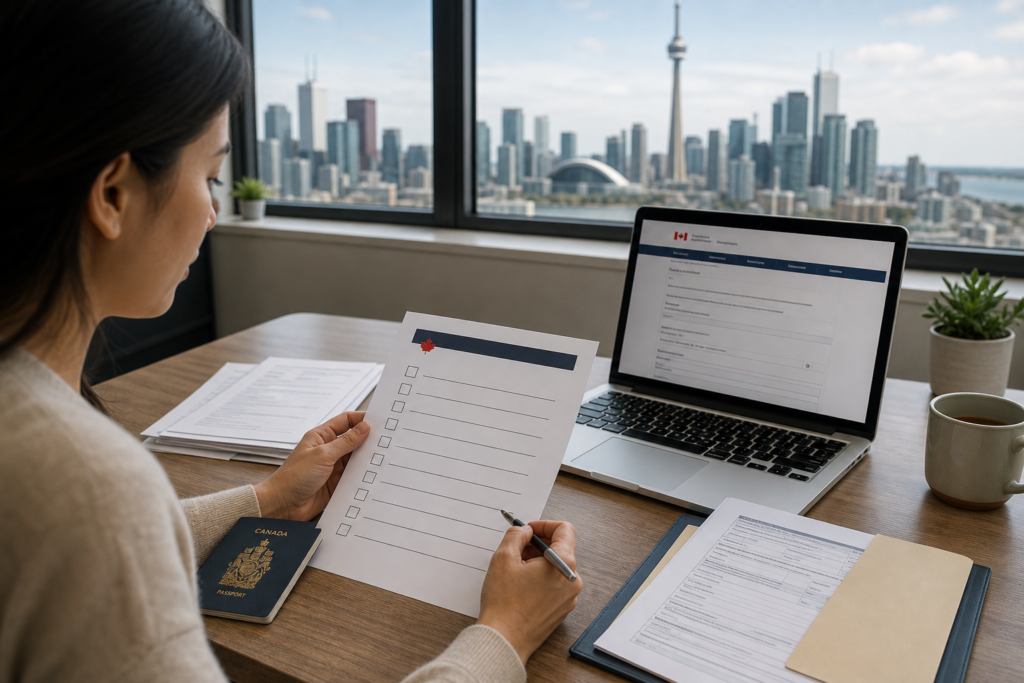
Treat the final review as a separate stage. Compare the package line by line with the current checklist for the correct stream and mark each item as included, not applicable with an explanation, or outstanding.
- The program name and applicant category are correct.
- All forms are current, complete, signed, and dated.
- Names, dates, addresses, employment history, and family relationships match.
- Required translations, declarations, photographs, and identity documents are included.
- Any unavailable document or unusual circumstance has a clear explanation and supporting evidence where possible.
- Federal and Ontario checklists have both been reviewed when both processes apply.
- Documents are arranged and submitted in the required order.
- A complete copy of the package and proof of submission have been saved.
Do not confuse caregiver immigration with Ontario caregiver supports
Some people search for a caregiver program because they care for a relative in Ontario, not because they want to immigrate as a caregiver. These are different questions. Ontario family caregiver leave concerns employment leave, while EI caregiving benefits involve separate eligibility and application requirements.
Ontario also provides information about home and community care for people who need assistance. These supports may help families caring for an older adult or someone with a health condition, but they do not replace IRCC or OINP forms and do not create an immigration pathway.
Review the separate information about Ontario family caregiver leave, EI caregiving benefits, and Ontario services for families and caregivers if your question concerns caring for a relative already in Ontario.
When regulated immigration assistance may help
Professional assistance may be useful when the correct stream is unclear, family history is complex, documents conflict, or a previous application creates additional questions. Before retaining anyone, verify current regulatory standing, confirm the scope of representation, and ask which pathway and checklist they are addressing.
Ararat Canada Immigration is based at 1200 Bay Street in downtown Toronto and states that it provides caregiver immigration services to clients worldwide. Its official site identifies Kaiwan Ahmed Shori as a Regulated Canadian Immigration Consultant with Class L3 RCIC-IRB unrestricted practice and states that the firm represents clients before IRCC, the Immigration and Refugee Board, and the Canada Border Services Agency.
The firm also states that its Toronto office, website, email, and listed social channels are its only official contact points and that it has no branches or agents in other countries. These facts do not guarantee an outcome. An initial consultation should clarify the applicable stream, evidence, limitations, and responsibilities.
Frequently asked questions
Can I use the same checklist for every caregiver immigration program in Canada?
No. The Live-in Caregiver Program, Home Care Worker Immigration Pilot streams, and Ontario provincial checklists address different processes. Use the checklist connected to your exact stream and application situation.
Is the Live-in Caregiver Program open to new applicants?
IRCC states that it is closed to new applicants. Its guidance describes a limited situation involving a caregiver who already has a program work permit, has found a new employer, and has an approved LMIA.
Are Ontario family caregiver leave and caregiver immigration the same thing?
No. Family caregiver leave is an Ontario employment standard, and EI caregiving benefits are a separate benefits process. Neither is an immigration application or a substitute for federal or provincial immigration instructions.
What should I do if a required document is unclear or unavailable?
Do not submit an unreadable record or silently omit it. Check the applicable instructions for alternatives, obtain a clearer copy or translation where possible, and prepare an explanation with supporting evidence if the document cannot be obtained.
Conclusion: Use the checklist for the right pathway
The most important item on a caregiver program Ontario checklist is the first one: identify the correct immigration pathway before collecting documents. Then review the applicant and family structure, employment evidence, identity records, stream-specific language and education documents, translation rules, and final consistency of the package.
Keep Ontario caregiver leave, EI benefits, and community support information separate because those services address different needs. If your stream or documentation is uncertain, verify the current official instructions and consider regulated assistance before submitting.
For caregiver immigration guidance from its Toronto-based consultancy, contact Ararat Canada Immigration through its official website to discuss the pathway and document requirements relevant to your situation.