
Check Super Visa Canada insurance in sequence: confirm the current requirement on the official Immigration, Refugees and Citizenship Canada (IRCC) pages, review the policy wording with the insurer, and compare the policy documents with the rest of the application. Do not rely on an old quote, informal summary, or agent’s assurance that a policy will be accepted.
Insurance is one part of a Super Visa application, not the application by itself. The applicant and Canadian host should verify both the insurance evidence and the wider eligibility and document requirements before submitting anything.
1. Confirm the current official Super Visa requirement
Begin with the IRCC eligibility page and the official forms and documents page. These are the appropriate starting points for confirming what evidence is currently expected from a Super Visa applicant.
Do this before purchasing insurance or relying on a previous application. Online articles, quotes, social media posts, and advice from friends may be outdated or describe a different applicant’s circumstances. IRCC has also published a notice about changes to the health insurance requirement, so check current government information rather than assuming an older checklist still applies.
Stop point: If the government pages, a previous checklist, and an insurer’s explanation do not match, pause the application and clarify the requirement before buying a policy or submitting documents.
2. Match the policy to the applicant

Check that the policy is issued for the person who will apply. Compare the following details on the policy certificate or confirmation:
- The applicant’s full name and spelling.
- Identity details shown by the insurer, where applicable.
- The policyholder or purchaser information.
- The intended travel or coverage dates.
- The policy number or other insurer reference.
Use the policy documents themselves, not only a quotation screen or email summary. If a host or family member purchased the policy, ensure that both the purchaser and insured person’s information are clear.
Stop point: Do not proceed if the name is misspelled, the policy appears to cover someone else, or the dates and identity information cannot be explained. Ask the insurer to correct or clarify the document.
3. Read the coverage wording and limitations
A policy quote is not the same as understanding the policy. Read the certificate, wording, exclusions, and conditions. Look for:
- Stated benefits.
- When coverage starts and ends.
- Exclusions, medical conditions, waiting periods, or other limitations.
- Conditions that could affect a claim.
- Cancellation, refund, or amendment terms.
- The claims procedure and contact information.
Do not assume a policy is suitable simply because it is marketed as “Super Visa insurance.” Compare its wording with the current official requirement and the applicant’s circumstances. IRCC confirms the immigration requirement; the insurer explains the policy’s benefits and limitations.
Stop point: If you cannot explain what is covered, when it applies, or which exclusions may affect the applicant, ask the insurer or a licensed insurance professional for written clarification.
4. Confirm the insurer and policy documents directly
Immigration and insurance questions are related but different. Ask the insurer or licensed insurance professional to confirm:
- Whether the applicant is eligible under the insurer’s rules.
- Whether the policy wording reflects the documentation requirement being checked.
- Whether payment is complete and how that status is documented.
- Which certificate, receipt, confirmation, or wording should be retained.
- How changes, cancellation, extensions, and claims are handled.
Keep written responses with the policy documents. They may help resolve inconsistencies, but they do not replace documents requested by IRCC or a review of the complete application.
Stop point: If you cannot verify the insurer, payment status, or proof of purchase through a reliable official channel, pause and avoid sending money or personal information to an unverified intermediary.
5. Compare the insurance papers with the application
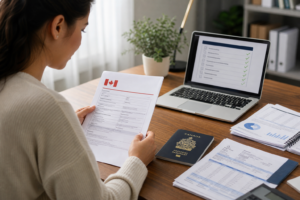
Before submitting, conduct a document-to-document check. Review:
- Names and spellings across the passport, forms, policy certificate, and supporting letters.
- Dates of birth and other identifying information.
- Policy dates and travel information.
- Policy numbers and references in supporting documents.
- Canadian host and family relationship information.
- Translations and required supporting formats.
Use the IRCC document instructions to confirm the application package. This checklist is not a substitute for current official requirements.
Stop point: If documents conflict, do not silently alter information. Determine which record is correct, obtain corrections where needed, and explain any material discrepancy appropriately.
Super Visa insurance verification table
| What to check | Why it matters | Who can confirm it |
|---|---|---|
| Current government requirement | Requirements may change, making old checklists unreliable. | IRCC’s current eligibility and document pages |
| Applicant and policy details | Incorrect names, dates, or references can create avoidable questions. | The insurer or licensed insurance professional |
| Benefits, exclusions, and conditions | A marketing summary may omit important limitations. | The insurer or licensed insurance professional |
| Payment and proof of purchase | A preliminary quote may not show final policy status. | The insurer and current IRCC instructions |
| Application consistency | Conflicting information can make the file unclear. | The applicant and an authorized immigration representative, if retained |
| Overall application strategy | Insurance does not address every immigration requirement. | A regulated Canadian immigration professional |
When should you stop and clarify the file?
- The official IRCC pages have changed since you received the quote or checklist.
- The policy wording differs from the sales explanation.
- The insurer’s eligibility or authority cannot be confirmed.
- Payment or proof of purchase is incomplete.
- The policy does not match identity documents or application dates.
- A document requires translation or clarification.
- An unofficial agent pressures you to pay or submit immediately.
Use independently confirmed official contact information if someone appears to misrepresent an immigration service or insurer.
Who can confirm each part of the application?
- IRCC: Current Super Visa eligibility and document instructions.
- An insurer or licensed insurance professional: Benefits, exclusions, eligibility, payment, cancellation, and claims.
- A regulated immigration professional: How insurance evidence fits within the wider application and whether representation is appropriate.
A Canadian immigration consultant does not replace an insurer, and an insurer does not assess every part of a Super Visa application.
Frequently asked questions
Is an insurance quote enough for a Super Visa application?
Do not assume it is. Check the current IRCC document instructions and ask the insurer which certificate, receipt, policy wording, or confirmation demonstrates the required details. A preliminary quote may not show final policy or payment status.
Who should answer questions about exclusions or claims?
Ask the insurer or a licensed insurance professional. They can explain benefits, exclusions, conditions, cancellation terms, and claims. An immigration representative can assess how documents fit the application but should not interpret the insurance contract.
Can an immigration consultant review the broader Super Visa application?
A regulated immigration professional may review the broader application and document consistency, subject to the services they provide. This is different from insurance advice, which should come from the insurer.
Conclusion: Verify the policy, then review the whole application
Check Super Visa Canada insurance in order: confirm the current IRCC requirement, match the policy to the applicant, read the full wording, verify the documents with the insurer, and compare relevant details with the application. If anything is unclear, stop and clarify it before submitting.
Ararat Canada Immigration provides Super Visa assistance to clients worldwide from Toronto. The firm identifies Kaiwan Ahmed Shori as a Class L3 RCIC-IRB authorized to represent clients before IRCC, the Immigration and Refugee Board, and the Canada Border Services Agency. Learn more through the firm’s official website information.