A successful visitor visa application must do more than show a desire to travel. You need to establish your identity with a valid travel document, meet health and admissibility requirements, show that you can support your stay, explain a genuine temporary purpose, demonstrate meaningful ties to your home country, and convince an immigration officer that you will leave Canada at the end of your visit. The exact requirements and documents depend on your circumstances and travel document.
A visitor visa, also called a temporary resident visa, is an official document placed in a passport. Most travellers need one to travel to Canada, although visa requirements vary and some travellers may also need one when transiting through a Canadian airport. You can confirm the basic visitor visa eligibility requirements through the Government of Canada before preparing your application.
1. Is your passport valid for the planned application?
A valid passport or travel document is the starting point for a visitor visa application. The application instructions state that you must provide a digital copy of a valid passport or travel document. They also advise that it should be valid for at least six months from the date you plan to travel. If it will expire sooner, renewing it before applying can help you avoid preparing an application around a document that may not meet the stated guidance.
Before submitting, compare the identity details in your forms with the biographical page of your passport. Check your name, date of birth, passport number, issuing country, and expiry date. If you have previous travel documents or relevant travel history, make sure the information you provide is accurate and complete. The official visitor visa application instructions explain the document-copy requirements and the need to renew a passport when necessary.
2. Does your evidence tell one consistent story?

One of the most important visitor visa Canada requirements is credibility. Your application should present a clear connection between your stated reason for visiting, the proposed travel plans, your finances, and your plan to return home. Problems can arise when dates, employment details, family information, travel history, or financial explanations differ between forms and supporting documents.
Read the forms and evidence together. Ask whether an officer could understand who is travelling, why the visit is temporary, who will pay for it, where the applicant’s ongoing responsibilities are located, and what will happen after the planned visit.
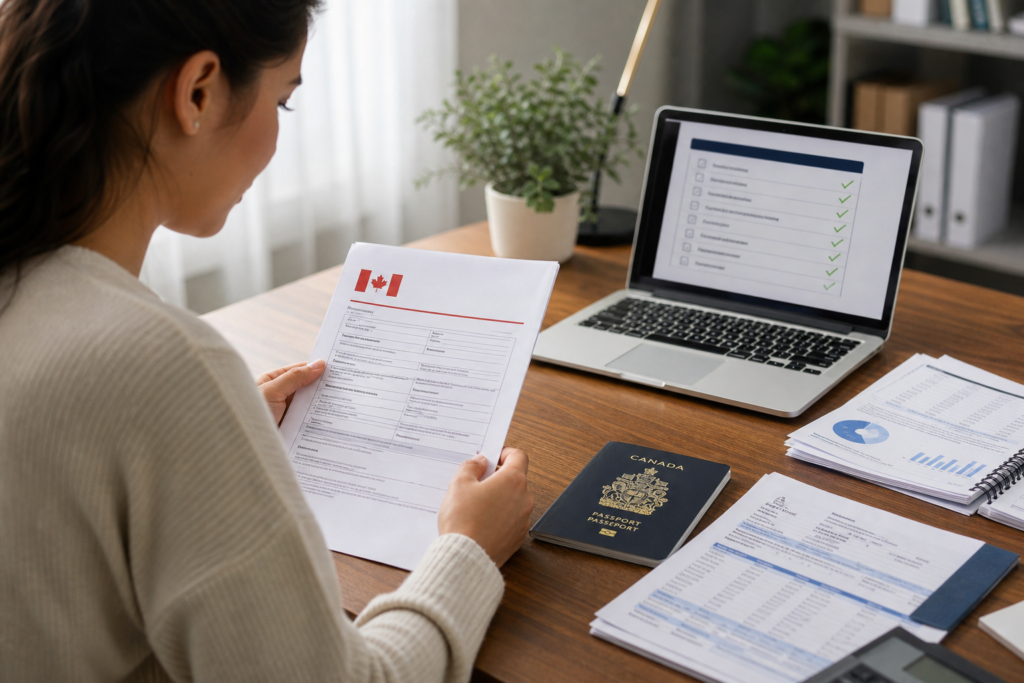
Online applicants receive a personalized document checklist in the application portal. That checklist should guide the documents you provide. There is no single universal package appropriate for every visitor, so avoid copying another applicant’s submission without checking whether it fits your circumstances. Provide truthful, complete information and explain any genuine inconsistency rather than leaving it unexplained. Canada’s border guidance also emphasizes truthful and complete information when speaking with a border services officer.
3. Can you credibly support the visit?
Applicants must have enough money for their stay. However, the requirement is not a universal bank-balance threshold that applies identically to everyone. The amount and evidence that make sense depend on the proposed visit, the applicant’s circumstances, and the costs the applicant is expected to cover.
Review the financial evidence as an officer might. Does it appear consistent with the applicant’s employment or business activities? Is the source of the money understandable? Does the proposed trip appear realistic in relation to the available funds and stated arrangements? If someone else will pay for some or all of the visit, clearly explain that arrangement and how it relates to the overall plan.
A sudden unexplained deposit or an account balance presented without context may not answer the underlying question: whether the applicant can reasonably support the visit. Assemble financial evidence that is accurate, current for the application, and connected to the explanation in the forms. The Government of Canada identifies sufficient funds for the stay as part of the basic visitor visa eligibility requirements.
4. Are your reasons to return home clearly documented?
A temporary visit requires more than a statement that you intend to return. You must convince an immigration officer that you will leave Canada at the end of the visit. Evidence of ties may include employment, a home, financial assets, or family in your home country. These are examples of the types of ties Canada considers, not a guaranteed checklist for every applicant.
The practical question is whether your evidence shows continuing responsibilities outside Canada. Consider what you are expected to resume after the planned visit, how your employment or business will continue, where your household responsibilities are based, and whether your financial or family circumstances support the return plan. A document should do more than exist; it should help explain the temporary nature of the trip.
Self-audit your return plan by asking: What specific circumstances make returning home logical and expected after this visit? If the answer is unclear from the application, identify what evidence or explanation is missing before submitting. The official eligibility and arrival information both identify ties and the intention to leave Canada as central considerations.
5. Have you addressed health and admissibility concerns?
Basic eligibility includes being in good health and having no criminal or immigration-related convictions. These issues should not be ignored because an applicant hopes they will not affect a temporary visit. Inaccurate, incomplete, or inconsistent disclosure can create a separate credibility concern.
Review the questions and instructions carefully, and disclose relevant information as required. If your history includes a prior refusal, an immigration violation, a criminal matter, or a health-related concern, avoid making a personal admissibility conclusion based on a general online checklist. The significance of a particular fact depends on the circumstances and applicable rules.
Consider professional review when your history is complex or when you are unsure how to present it accurately. A regulated representative can help identify information that needs careful explanation, although no representative can guarantee a visa or admission decision. The Government of Canada’s eligibility guidance sets out the relevant basic health, criminal, and immigration-related requirements.
6. Do you understand what a visa does and does not establish?
A visitor visa is evidence that you meet the requirements needed to travel to Canada as a visitor. It does not remove the need to satisfy Canada’s entry requirements when you arrive, and it does not guarantee admission. Visitors must provide truthful, complete information to a border services officer and comply with the requirements that apply to entry.
Before travelling, make sure your explanation at the border remains consistent with your application. Be prepared to explain the purpose and length of your visit, your arrangements, your available funds, and your plans after the visit. The Canada Border Services Agency’s visitor information explains that travellers must meet entry requirements and provide truthful, complete information on arrival.
Visitor visa or visitor record?
These documents are related to visiting Canada but are not interchangeable.
| Document | What it generally does |
|---|---|
| Visitor visa | An official document placed in the passport of travellers from visa-required countries. It allows them to travel to Canada and seek entry as a visitor, subject to requirements at the border. |
| Visitor record | A document a border services officer may issue to extend or restrict a person’s stay in Canada. It is not the same document as a visitor visa. |
The official explanation of visitor visas and visitor records provides the distinction.
A final self-audit before submitting
Use these questions to review your application as a whole:
- Is the passport or travel document valid, and does it follow the application guidance?
- Have you followed the personalized IRCC document checklist?
- Do the stated purpose, dates, travel details, family information, and supporting documents agree?
- Are the funds credible for the proposed stay, and is their source understandable?
- Does the evidence clearly support your employment, home, family, financial, or other ties outside Canada?
- Have you answered health, criminal, and immigration-history questions accurately and completely?
- Do you understand that you must still meet entry requirements and answer questions truthfully at the border?
Processing times vary according to factors such as the type and completeness of the application, how easily information can be verified, and how quickly an applicant responds to requests or concerns. When biometrics are required, the time to provide them is not included in the processing-time estimate. Check the current visitor visa processing information rather than relying on an old estimate.
When might regulated representation be worth considering?
Many applicants can begin by reviewing the official requirements and preparing their own documents. Regulated representation may be worth considering when you are uncertain about the correct approach, have experienced a previous refusal, have admissibility concerns, are dealing with complex family circumstances, or find it difficult to present your evidence clearly and consistently.
When choosing help, confirm who will provide the service and whether that person is authorized to represent clients for the matter involved. Ararat Canada Immigration states that it serves clients worldwide from Toronto and provides visitor visa and Super Visa services as part of its broader Canadian immigration, citizenship, and refugee practice. The firm states that its founder, Kaiwan Ahmed Shori, is a Regulated Canadian Immigration Consultant with RCIC-IRB Class L3 Unrestricted Practice and that the practice is authorized to represent clients before IRCC, the Immigration and Refugee Board of Canada, and the Canada Border Services Agency.
Are your visitor visa Canada requirements supported by clear, consistent evidence?
The strongest final review is not a search for one magic document or a guaranteed bank balance. It is a reasoned check that your identity and travel document are valid, your evidence is complete and consistent, your funds are credible for the proposed stay, your ties support a return home, and any health or admissibility concerns have been addressed accurately. You should also understand the difference between permission to travel as a visitor and the separate assessment that takes place when you arrive.
Resolve gaps before applying, follow the personalized instructions in the application portal, and use current Government of Canada and CBSA information. Good preparation can make your circumstances easier to understand, but it cannot guarantee a visa or entry decision.
For an assessment or representation, Ararat Canada Immigration is a Toronto-based consultancy serving clients worldwide, with visitor visa services included in its broader practice. The firm states that it is led by Kaiwan Ahmed Shori, RCIC-IRB Class L3, and asks clients to use its official website and listed official channels.