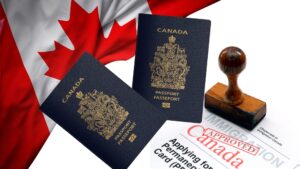

Most permanent residents apply for a grant of Canadian citizenship if they have valid permanent resident status and at least 1,095 days of physical presence in Canada during the five years before applying. If a parent may have been Canadian when you were born, investigate citizenship by descent first, because you may already be Canadian. Related reading: Can non canadians buy property bc.
Start with the correct Canadian citizenship route
A grant application is generally for a permanent resident seeking citizenship through residence in Canada. Citizenship by descent is different: it asks whether you already hold Canadian citizenship through a parent or another qualifying connection.
- Permanent resident seeking naturalization: review the grant-of-citizenship requirements.
- Possible Canadian parent or family connection: investigate proof of citizenship before filing a grant application.
- Unclear route: organize your identity, status, family and travel records before submitting or paying.
Most permanent residents follow the regular application process. The official citizenship overview explains the available routes.
Eligibility checks before you apply
Check your permanent resident status, physical presence, language evidence and age-related requirements before completing the forms. Your travel history and personal information must also remain accurate while IRCC processes the application.
Valid permanent resident status
Adult applicants must have permanent resident status in Canada. A PR card and citizenship eligibility are separate questions. If you have a residency-obligation concern, removal history, status issue or complicated immigration record, obtain a case-specific review before signing.
At least 1,095 days in Canada
You generally need at least 1,095 days physically present in Canada during the five years immediately before applying. Record every absence and use the official physical-presence calculator guidance.
Do not rely on memory if you travelled frequently, changed passports or have address gaps. Your calculation should agree with the dates and immigration history elsewhere in the application.
Language and knowledge requirements
Some applicants must provide proof of English or French ability. Applicants aged 18 to 54 must take the citizenship knowledge test, and IRCC sends an invitation after receiving the application. Check the current instructions because age and circumstances affect the evidence required.
Continuing requirements
Eligibility does not end on submission. You may need to update physical-presence information, attend a test, interview or ceremony in Canada, and continue meeting the requirements while your file is processed.
A hypothetical applicant with few trips and consistent records may mainly need to verify the calculation. Someone with frequent international travel should reconcile passports, travel dates, addresses and employment records before relying on the total.
Documents and information to prepare
A Canadian citizenship application requires more than a completed form. The current CIT 0002 instructions set out the adult application requirements.
| Category | Purpose | Checks before submission |
|---|---|---|
| CIT 0002 | Core adult application form | Use the current version and answer every applicable question. |
| Identity and civil documents | Confirm identity, family details and name history | Compare spelling, dates and name changes across records. |
| PR records | Support immigration history and status | Review landing records, PR documents and status changes. |
| Travel and address history | Support the five-year physical-presence calculation | Reconcile trips, passports, addresses and time abroad. |
| Language evidence | Show English or French ability where required | Confirm the evidence is accepted and details match. |
| Photographs | Meet citizenship photo requirements | Follow current format, dimensions, date and identification rules. |
| Translations | Make documents usable when they are not in English or French | Use the prescribed translation and affidavit format where required. |
| Explanations | Address gaps, prior refusals or inconsistent records | Write a factual chronology and support it with relevant documents. |
The adult forms and documents guidance explains the current paper requirements. Age, application type and personal circumstances can change what you need.
Online or paper application: which method fits?
Neither method is universally better. Choose the option you can complete accurately, document fully and monitor reliably under the current IRCC instructions.
| Consideration | Online | Paper |
|---|---|---|
| Access | Useful if you can use the required account and upload accepted files. | Useful where paper filing is available and easier to manage. |
| Documents | Digital uploads are convenient, but formats and legibility still matter. | Printed copies require careful assembly and delivery records. |
| Records | Save every answer, upload and confirmation outside the account. | Scan the signed package and retain payment and delivery proof. |
| Complex history | Suitable if the portal accommodates your explanations and evidence. | Suitable where an indexed paper package presents the history clearly, if permitted. |
Pay the current fee through the official process and retain the receipt. Fees can change, so check the current IRCC fee list immediately before filing.
The application journey from preparation to submission
To apply for Canadian citizenship, select the correct route, confirm eligibility, complete the current package, pay the fee, submit through the permitted method and monitor IRCC communications. Submission does not guarantee approval.
- Confirm the route. Decide between a grant application and investigating citizenship by descent.
- Calculate presence. Review the five years before signing and resolve discrepancies.
- Build the package. Gather identity, status, travel, address, language, photo and translation evidence.
- Complete the forms. Check every date, address, name, trip and family detail.
- Pay the fee. Save proof of payment.
- Submit and retain copies. Keep the complete package, confirmation and delivery evidence.
- Monitor the file. Watch for acknowledgements, requests, test instructions and ceremony notices.
What happens after you submit?
IRCC may acknowledge the application, review it, request information, invite eligible applicants to a knowledge test, and arrange an interview or ceremony. The post-submission process is not identical for every applicant.
Checking status
Use the current IRCC status process and the account or tracking instructions connected to your application. Keep your application number, receipt and correspondence together.
Responding to requests
Read each request carefully, note the deadline and provide the specified evidence in the required format. If a document is unavailable, explain why and show what steps you took to obtain it.
Travel and changes
Travel after submission does not automatically end the application, but absences can affect information IRCC needs and your availability for a test, interview or ceremony. Update your address, email and telephone number when they change. The official post-submission guidance explains continuing obligations.
Returned applications
A returned package is different from a refusal. Identify whether the issue was an incomplete form, missing photograph, fee or document, then correct the stated problem and review the entire package before resubmitting.
Can you speed up processing?
There is no general step that guarantees faster processing. Accurate information, legible documents, the correct fee and prompt responses help prevent avoidable delays. Do not pay anyone who promises approval or special influence over IRCC.
Processing times and complications
IRCC processing times are estimates, not promises. Check the current official estimate when planning because requirements and timelines can change, and files involving travel, identity, status or document questions may take longer.
If your application appears to exceed the published estimate, confirm your contact details, check your account and correspondence, review outstanding requests and use the official enquiry process available for your file.
Consider a case-specific review before applying if you have a prior refusal, extensive or uncertain travel, immigration-record gaps, possible misrepresentation, criminality or admissibility concerns, or conflicting names and dates.
When citizenship application assistance may help
General information may be enough when your route, PR records, travel history and documents are straightforward. Professional assistance can be useful when you need help choosing the route, explaining a complicated history, reviewing a refusal or responding to an IRCC request.
Its website identifies Kaiwan Ahmed Shori as a Regulated Canadian Immigration Consultant and states that the practice is authorized to represent clients before IRCC, the Immigration and Refugee Board of Canada and the Canada Border Services Agency.
For information about Ararat Canada Immigration’s citizenship application service, review the service page and contact the firm through its official channels.